EN: Sound Engineer · MA Student at BIMM Berlin
DE: Tontechniker · Masterstudent an der BIMM Berlin
RO: Inginer de sunet · Masterand la BIMM Berlin
OPINION - mIxing is routing, clip gain, phase alignment
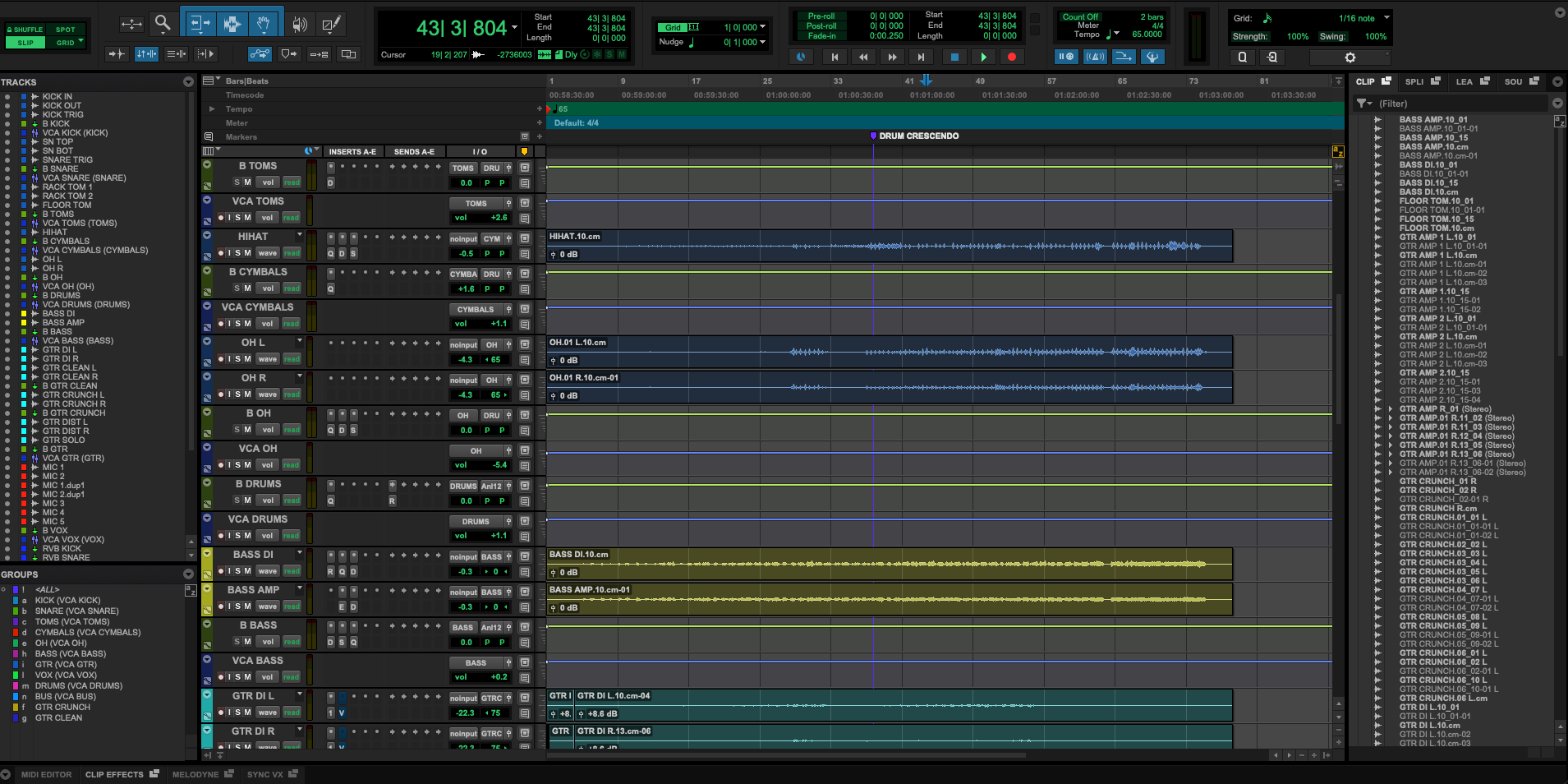
Before a single plug-in gets opened, most of a mix is already decided: how the tracks are named, grouped, routed, gain-staged and time-aligned. That’s what this post is about. What you’re looking at is my session from 2024, when I recorded and mixed friends of mine from uni. The band broke up and they won’t let me put the song online, so you only get the screenshots - which is fine, because the way a mix gets built is largely universal.
You’re looking at the Edit window. This is where clip gain lives, and where you do time alignment, phase nudges, polarity flips (everyone says phase invert) and commits. Fancy jargon for very simple actions: moving audio around, and deciding how loud a piece of it is before anything else touches it.
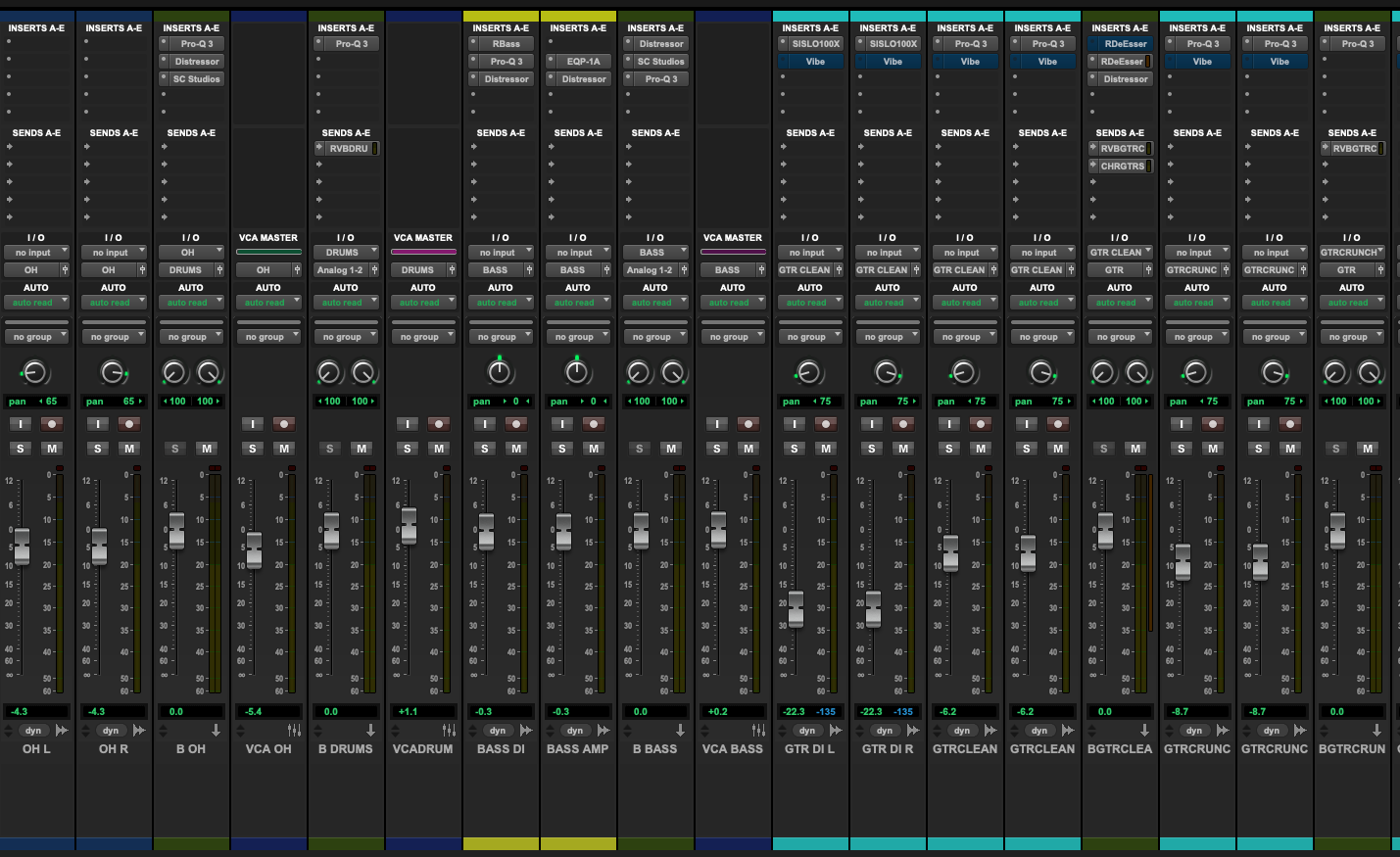
You’re looking at the Mix window, which lays the session out like a console: a channel strip per track, inserts at the top, sends under them, then I/O, pan, and the fader. Pro Tools didn’t invent that layout and it’s not the only DAW that uses it, but it landed early in professional studios, and between its editing workflow and the hardware built around it, it became the default in a lot of studios and in post. That’s habit and infrastructure as much as merit.
You’ll notice tracks named BUSS (I shorten it to B) and tracks named VCA, and faders sitting at all sorts of levels. Those two are not the same thing: a buss - an aux input - actually sums audio, so the drum tracks feed into it and you can process the sum. A VCA passes no audio at all, it scales the faders of every track assigned to it, so the balance you set inside the group stays intact. Setting the level relationships across all of that is what balancing means. Pro Tools mixes in floating point so the internal sum won’t break, but the output has a hard ceiling and anything modelling analog gear cares about level, so I leave headroom anyway. Some tracks sit far below the rest and still do work - notice the two GTR DI tracks pulled way down but still active. I liked what they added underneath the amped guitars, so I kept them.
I want to say this loudly, because I don’t see it come up much. Most of the mixing talk I read is about plug-in A versus plug-in B, or which one is AI-powered now. I don’t like mixes that are technical for the sake of it, where the EQ curve looks like a maths exam.
I was taught this at uni, and I don’t think it landed the way it should have. Most of us heard it and filed it under the wrong heading: we confuse setting up a mix - the FOUNDATION - with sitting in front of a plug-in for two hours - the TECHNICAL part.
Here’s what I mean by FOUNDATION:
TRACK IMPORT. NAMING. COLOURING. GROUPING - BUSSES - VCA FADERS - SENDS. ROUTING. CLIP GAIN. PHASE AND TIME ALIGNMENT. COMPING. PANNING. VOLUME FADER ADJUSTMENT
Phase alignment sits on that list and it’s the one people skip. Whenever a source is captured by more than one mic - kick in and kick out, snare top and bottom, a DI next to a mic’d cab - the same event reaches each mic at a slightly different time. Sum them and that delay cancels some frequencies and reinforces others. That isn’t a tone you chose, it’s a comb filter you inherited. So flip polarity on any mic pointing at the source from the opposite side, and nudge tracks until the transients line up. The DI against the cab is the clearest case: the DI hits the interface almost instantly while the cab has to push a metre or so of air, which is roughly three milliseconds late. Slide it and the guitars go from thin to solid without touching an EQ. Do this before you EQ, otherwise you’re EQ-ing the cancellation instead of the sound.
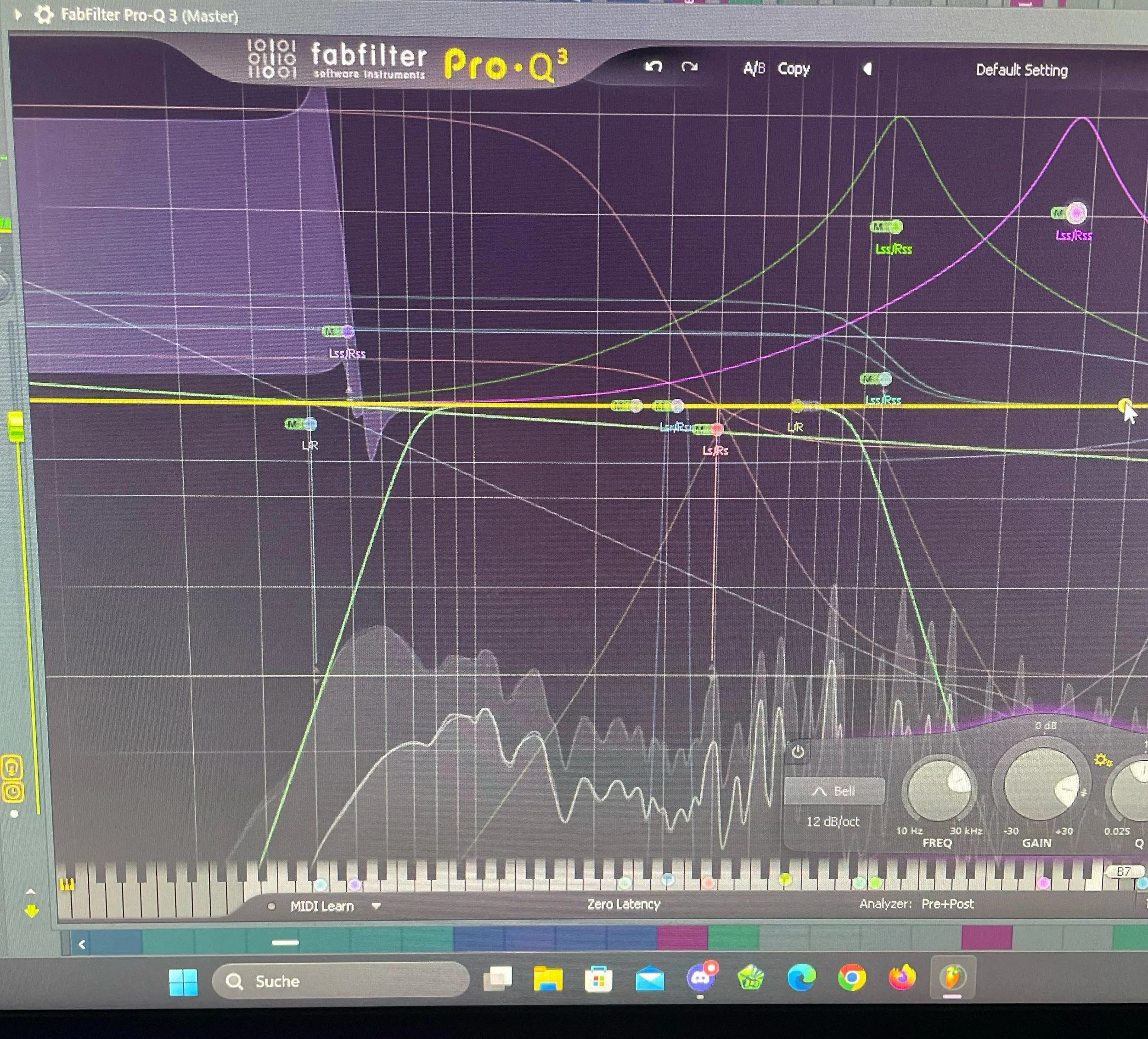
A ridiculous EQ configuration. It’s a joke, but I’ve seen people get uncomfortably close to it.
So here’s the point of the article. The session up there is packed with tracks, but I went easy on the plug-ins, and roughly 80% of my time went into learning how to:
name my tracks, so I can navigate the session instead of hunting through it
group tracks - kick, snare, hi-hat, overheads - so that one VCA DRUMS fader moves the whole kit while the balance I set inside the group stays where it was. It saves a huge amount of time
colour tracks. There are conventions for this too, and they matter most when a session is going back and forth with another engineer - it keeps the session readable and lets you take in a whole group at a glance
clip gain: in the Edit window you’re looking at the waveform of every track, and before any plug-in you bring those levels into a sensible range - roughly consistent from track to track, with plenty of headroom left. Two things come out of that. Level-dependent processors (compressors, saturators, anything modelling analog gear) behave predictably, and you start from a rough balance instead of chaos. Waveform height is a guide, not a loudness meter - a bass and a hi-hat that look the same size are nowhere near equally loud - so let your ears and a meter make the call. Clip gain does more than gain staging, too: pulling down a harsh s before the de-esser, or evening out a performance before the compressor ever sees it.
balancing volume across the whole board, so that I know what the song actually SOUNDS LIKE. It’s five minutes of moving faders, and it’s where you start to feel the song and where the mix should go.
more than that, but nothing I’ve listed needs a single plug-in. It’s understanding the environment you’re working in.
When the mix was finished I built a template out of it - every track already named, coloured, grouped, routed and roughly balanced - so that the next project starts by dropping the new tracks onto their corresponding template track.
That’s my recipe - or rather the recipe I was taught: structure and logic first, so that the creative decisions afterwards have something to stand on. Plenty of my mixes distort, I clip plug-ins constantly, but those are choices I make on purpose, out of experience and curiosity, not accidents I didn’t notice.
Definitions, c++ struct human(var rules)
I’m trying to piece this puzzle together as I’m writing.
Let’s try with basics. Sleep, eat, drink are boolean rules. A bool variable is either 0 or 1, means YES or NO just as well (semantics are TRUE and FALSE, but YES., NO work just fine here). Now, is sleep is “yes” then I successfully did this primary function. If sleep switches to “no” then I become sleepy and my body calls for rest. Same logic applies to eating and hydrating (clearer word than drinking).
What if sleep is NO and then I become irritated instead of sleepy? Is this the correct feedback my body should give if I’m not rested? Perhaps eat is also tuned to NO and together cause messy reactions.
Next set of rules should be basic operations that are quantified. Ability to walk, see, hear, speak, basic senses that range from 0 (non-existent or chronic) to n (maximum utility and coordination). Assume n is 5, if sight is 3, then I can postpone my optician if I’m, say, dehydrated, This suggests ability to prioritise essential bodily functions over “non life-threatening” situations. More on how layer 1 connects to layer 2 later..
Layer three should be around basic observational behaviour .Mapping a clause to a rule. If pan is on stove, then I don’t touch because I get burned. That is a new synapse that brings us ro layer 4. If I yell at my friends, they stop hanging out with me etc.
Layer four is noticing emotions.
Layer five is natural reaction to outside emotional moments.
Layer six is critical thinking, ability to abstract, deduct, predict.
Layer seven is wisdom and that is the true conclusion of a meaningful life,
Normally a child is born and flies through the first five layers. Then an adolescent builds upon layer six until he grows old, when his success will bring him to be wise.
How does my structure hold up? A normal person should be able to reach wisdom but often fails. I’ll wrap this post up more neatly tomorrow.
Writing when your brain won’t write
People feel conflicted so I’ve seen. About this. Some call it inspiration, others motivation. Now to be inspired calls for divine, mythical, that who cannot be called. So, these pretentious artists usually delay writing songs because Jesus said heroin was a better choice than the guitar.
The motivation warriors are equally fascinating. They talk as if crusaders in the Middle Ages. And yet, they (usually) tend to be more supportive towards one another, whereas the inspired people tend to isolate and assume leadership.
Here’s my problem: I like both angles. I understand how doing something that feels bad then can make you dislike said activity. Equally as much, some things need to happen regardless of how you feel.
So, is my guitar an inspiration, or motivation to make me want to write better songs? A line needs to be drawn in the sand somewhere, but it’s a close call hitting that line just right, otherwise failing abruptly due to terrible coping mechanisms.
What do I cope with usually? What do I know about coping? There’s good coping, there’s terrible coping. My yoga to your three-day techno club binging.
To each their own, but that’s forcing me into another matter entirely. Definitions. We have a set of rules that need be executed for us to work. And they’re all particular. More on that later.
(ROU) Nu TE CRED: CEVA NU SE ÎNȚELEGE
Ceva nu se-nțelege și pot să pun lesne întrebări la curs. Indiferent de felul în care sun. Mari șanse să nu fi fost eu ăla de-a avut curaj să-ntrebe despre reacțiile chimice reversibile. Clasa să râdă, ca după să constate ca nimeni nu pricepuse nimic, și singurul care-a dat înainte să fi fost eu. Trăiesc din ce în ce mai des momente de genul. Au o singură nuanță. Aia de taciturn care-i plin de vorbe premium și toți niște proști. Pe de altă parte, dacă nu țin eu cu mine, cine? Chiar ne-am tâmpit de tot?
Mă-ntorc la vorba lui Ilie Năstase. Mai întâi performanță. Vorbim noi după.
Beyond Loudness: Does Narrow Dynamic Range Bias Listener Preference When Loudness Is Held Constant?
Abstract
The “loudness war” — the decades-long escalation of average levels in commercial masters via compression, limiting and clipping — has historically been justified by the belief that louder recordings are preferred and sell better. Universal adoption of loudness normalisation by streaming platforms (now targeting roughly ‒14 LUFS) removes loudness as a competitive variable at the point of playback, yet heavily limited masters remain the norm. This study asks whether the dense-master aesthetic retains any perceptual pull once loudness is neutralised: specifically, whether reduced dynamic range and audible clipping bias listener preference independently of loudness, and whether that bias is absolute or relative to genre expectation. Using a double-blind design with stimuli matched on perceived loudness (ITU-R BS.1770 integrated loudness as the starting point, then a listener-adjusted and model-based perceptual trim, with true peak deliberately left free so dynamics survive), the study compares dynamic, transparently limited and hot-clipped masters all derived from a single owned source per song. In density-native genres a relaxed remix serves as the common parent from which every processing level is produced, so the only difference between conditions is the final-stage dynamics treatment. The controlled provenance permits public release of all stimuli, addressing a reproducibility gap in the existing literature.
Research Questions
With perceived loudness held constant, does dynamic-range reduction (transparent brick-wall limiting) shift listener preference relative to a dynamic master of the same source?
Does audible clipping distortion exert an effect on preference that is separable from dynamic-range reduction per se?
Is any such effect absolute, or does it interact with genre schema — i.e. is reduced dynamic range penalised in dynamic-tolerant genres but tolerated or preferred in density-native ones?
Does the effect differ between trained (audio-professional) and naïve listeners, and does it vary with each listener’s familiarity with and affinity for the genre?
Over longer continuous exposure, does heavy limiting/clipping produce measurable listening fatigue independent of momentary preference?
MUSIC IS MIXED TO MAKE US LIKE IT MORE!
Indiana Jones is memorable. Game of Thrones has a legendary soundtrack. I wonder if every song we hear reminds us of happy memories. Equally, I wonder if Mathematics behind the Sine Waves of a track are so precise we can now fool a listener into liking a song more because of Science. I’m planning to explore throughout my Master’s Thesis whether music is mathematically manipulated to make us like it more. Or whether it’s just talent. Are we going to listen to Queen off a barely working casette tape? Always! Would we say the same for Billie Eilish?
Washing His Hands of the Calendar
Why hiding Jesus from our timekeeping is the least inclusive thing we could do. The Sanitised Clock Somewhere in the last few decades of academic and institutional life, a quiet substitution was made. The labels BC and AD — Before Christ and Anno Domini, Latin for In the Year of the Lord — were replaced in scholarly writing, textbooks, and official documents with BCE and CE: Before Common Era and Common Era. The stated motivation was inclusivity. The actual effect was something closer to a conjuring trick — Jesus disappeared from the calendar, while the calendar itself remained entirely unchanged. This is worth sitting with for a moment. The numbering system is identical. The year that was 2000 AD is still 2000 CE. The year that was 500 BC is still 500 BCE. Not a single day was moved, added, or removed. The hinge point of all human recorded history — the birth of Jesus Christ — remains exactly where it always was, silently anchoring every date on Earth. We simply stopped saying his name. The question worth asking is: does this make the calendar more inclusive, or does it make us less honest about whose calendar it actually is?
audio post production. behind the scenes. scoring & movie sound
A scene is comprised of many cameras, a group of people that handle video recording, and equally as many people handling sound. This means actors’ voices, sound effects, then adding music scoring in post production. Here’s a look into how thorough parsing sound is.
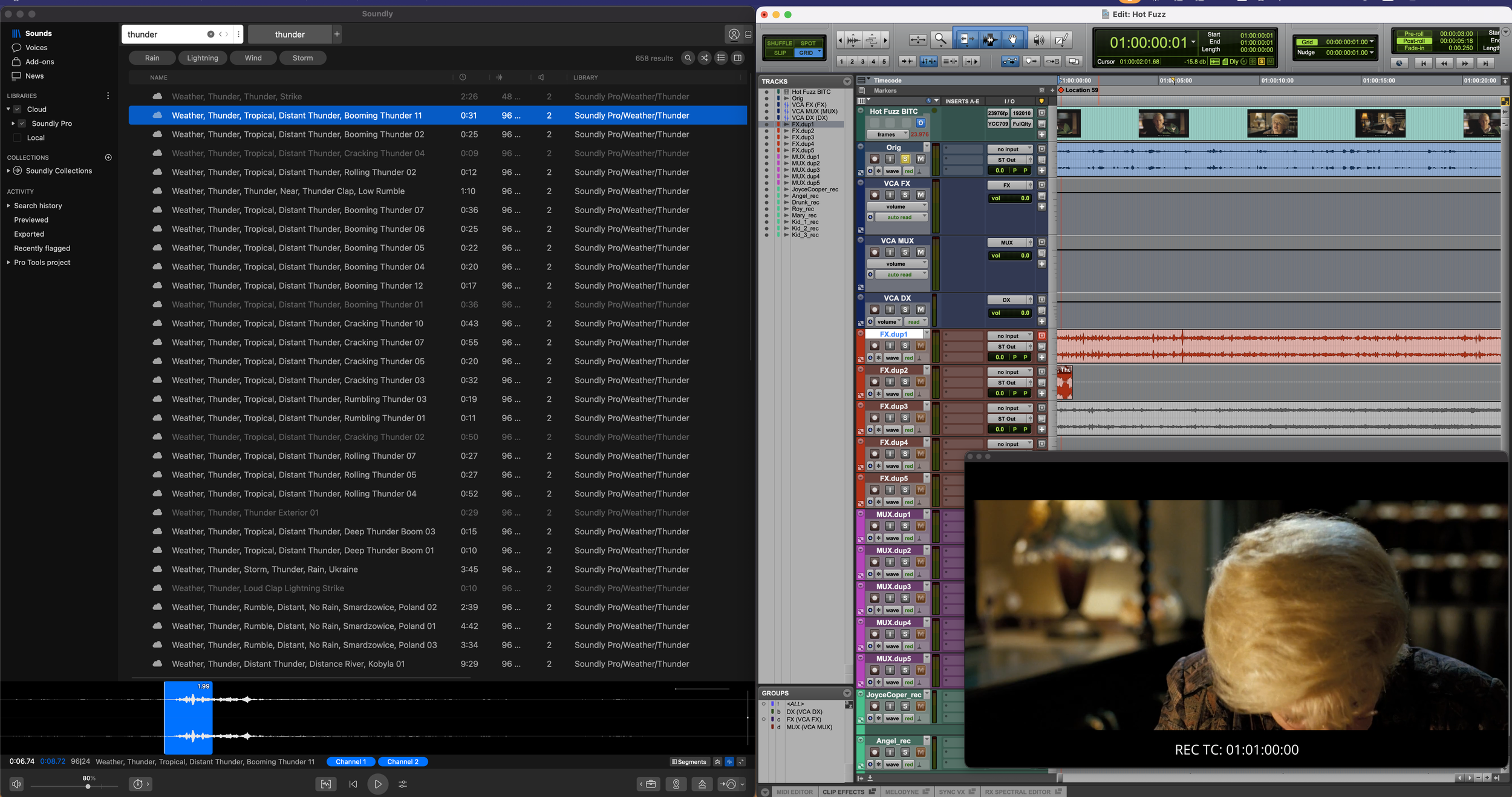
Figure 1: Typical audio workflow post-recording. Pro Tools (right) is one of the leading powerhouses of Audio Post Production. Seamless integration with Media Composer as both are Avid’s enterprise sound and video solutions. On the left side is an online library of sounds (Soundly), used for SFX insertion post-production e.g. rain, fireplace sounds, creaking doors, examples are endless.
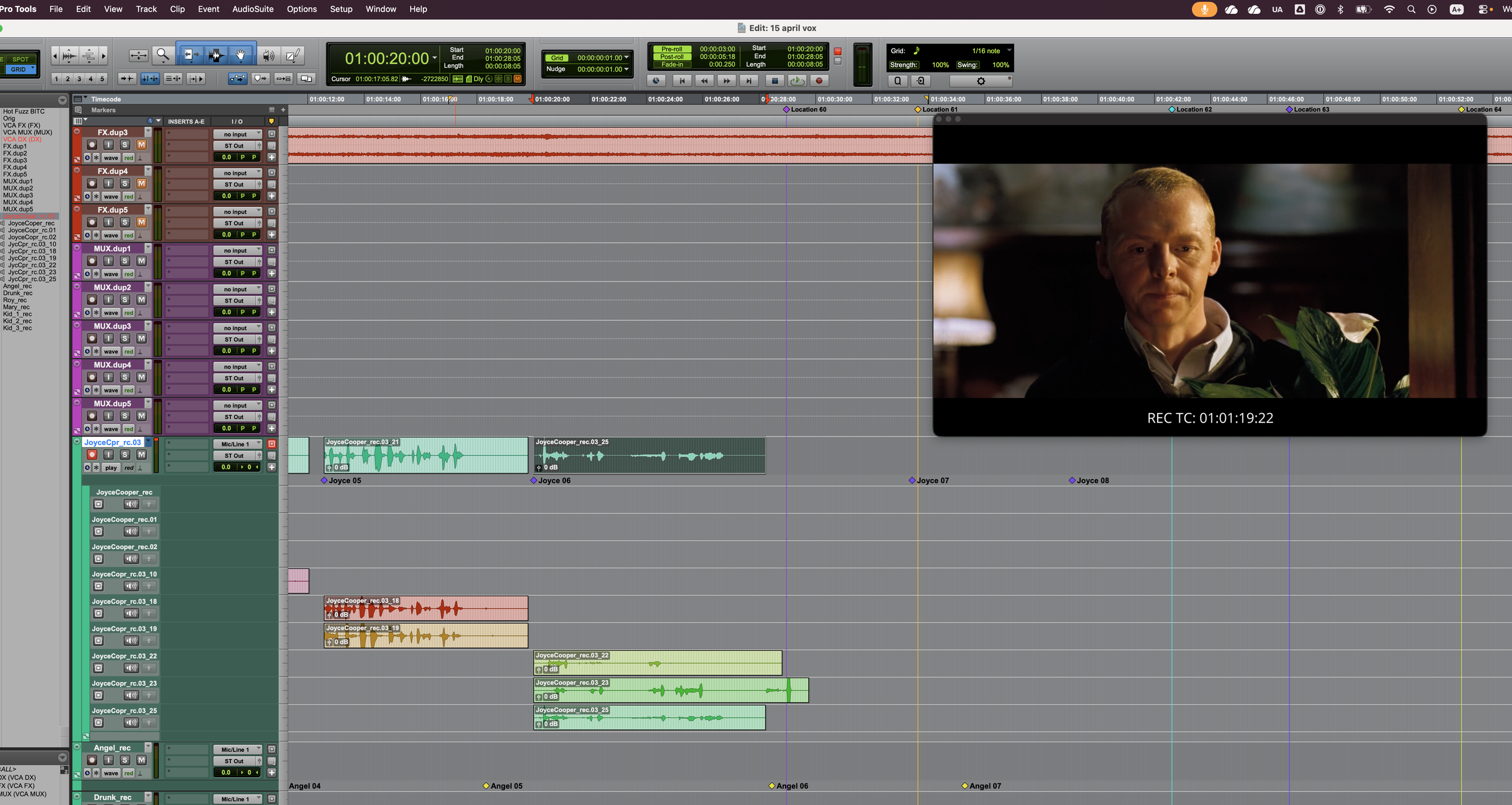
Figure 2: Pro Tools Playlist dubbing. This is most used in translating movies, but it’s also used for re-recording dialogue in case of field recording issues e.g. microphone misplacement, pops or muffled recordings.
the quick brown fox jumps over the apple magic keyboard
It’s interesting to learn that an Apple Keyboard can be so clumsy to use but still forces you to be decisive in your actions. Because when typing, maybe it’s not gibberish you’re meant to communicate through a keyboard, rather, careful, attentive decisions. Interesting discovery since I used to be an avid fan of mechanical keyboards, that was until now. Well, time will tell, that’s for sure.
when something snaps
So being blissfully positive carries its own risks usually, especially when thinking about near future and your ability to handle important tasks at hand, like work or getting a uni degree. I was incredibly fascinated by LSD, Ketamine, powerful transformative experiences that shape and redefine your understanding of how your life works. Sometimes that becomes a coping mechanism to always delay what you want to do, and then you’re usually kidding yourself. But, the silver lining is, when you reconnect with things that make you passionate, you stand a chance to forget and maybe look at yourself differently. I learned you can keep that colour and optimism, and to quiet whatever lingering thoughts hack at you when you’re learning and doing what you want to do, not what is expected to you. Life’s cute like that, and logging progress seems to help with grounding yourself always.
guitars, Eric clapton’s cocaine, inner ear
There’s so many things about life that you can’t really place properly and yet they cause so much joy. Think of a simple phone call, messages, a way to rearrange your room. Cocaine is infuriatingly dangerous because of its design, which goes like: yes, you do cocaine, now you want cocaine again. Cycle never ends, I wonder what Hunter Thompson liked most about this drug. Energy? Paranoia? Or maybe simply a break from what normal is? Nevertheless, I’m paying attention to my nose quite closely. I’m waiting for a Schecter guitar to come. I’m curious whether Schecter beats ESP/LTD in terms of quality control or if it feels better overall. I really like Les Paul shaped guitars, but I think it could be a good time for a change.
It doesn’t matter how you start playing guitar, just have fun with it
My logic is you don’t have to choose between acoustic or electric, or, worse, try to play guitar through tutorials. Choose a song you like, plug your guitar in, and then have the courage to play along with the song. You’ll be surprised how happy you’ll be when you’re the third Metallica guitarist.